Beyond Scans: Active Agents Validate Privacy Compliance

The Cost of Non-Compliance
In 2022, a major e-commerce platform found itself at the center of a regulatory storm, culminating in a €20 million fine levied under the European Data Protection Board's coordinated enforcement framework. The infraction was not a catastrophic database breach or a malicious insider threat. Instead, it was a systemic failure of operational execution: the platform failed to honor user requests for the right to erasure - commonly known as the right to be forgotten under General Data Protection Regulation (GDPR) Article 17 - within the legally mandated 30-day window defined in Article 12(3).
The company had invested heavily in its public-facing privacy portal. Users could easily log in, navigate to their account settings, and click a highly visible "Delete My Account" button. The user interface worked flawlessly, immediately displaying a reassuring confirmation message and dispatching an automated email promising that all personal data would be purged within 30 days. To any external auditor performing a point-in-time check, the compliance workflow appeared complete and compliant.
Behind the frontend, however, the system was fractured. The deletion request triggered an API call that successfully marked the user's primary record as inactive in the main transactional database. But the deletion signal never propagated to the company's legacy customer relationship management (CRM) platform, its third-party marketing automation tools, or its cold-storage data warehouses. Over the next month, the synthetic and real identities of users who had requested deletion continued to receive promotional emails, and their behavioral profiles remained active within the company's advertising audience segments.
When supervisory authorities investigated following consumer complaints, they uncovered thousands of unfulfilled deletion requests. The resulting €20 million administrative fine - representing the statutory maximums outlined in GDPR Article 83(5) for violations of basic processing principles and data subjects' rights - was only the immediate financial blow. The long-term damage manifested as a severe erosion of brand trust, a sharp increase in customer churn, and a permanent spot on the regulatory watchdog list, which triggered ongoing, invasive audits of their entire data processing infrastructure.
This case underscores a critical reality for modern digital enterprises: regulatory bodies are no longer satisfied with the mere existence of privacy policies and consent banners. Supervisory authorities across the globe - from the CNIL in France to the California Privacy Protection Agency (CPPA) - are actively shifting their enforcement strategies from passive documentation reviews to rigorous, behavioral audits. They are testing whether the promises made in a privacy policy are actually executed in the underlying software architecture. In this heightened regulatory environment, a single broken database trigger or an unmonitored API integration can quietly escalate into a multi-million dollar liability. To prevent these silent operational failures, organizations must shift their approach to how they verify their own compliance posture.
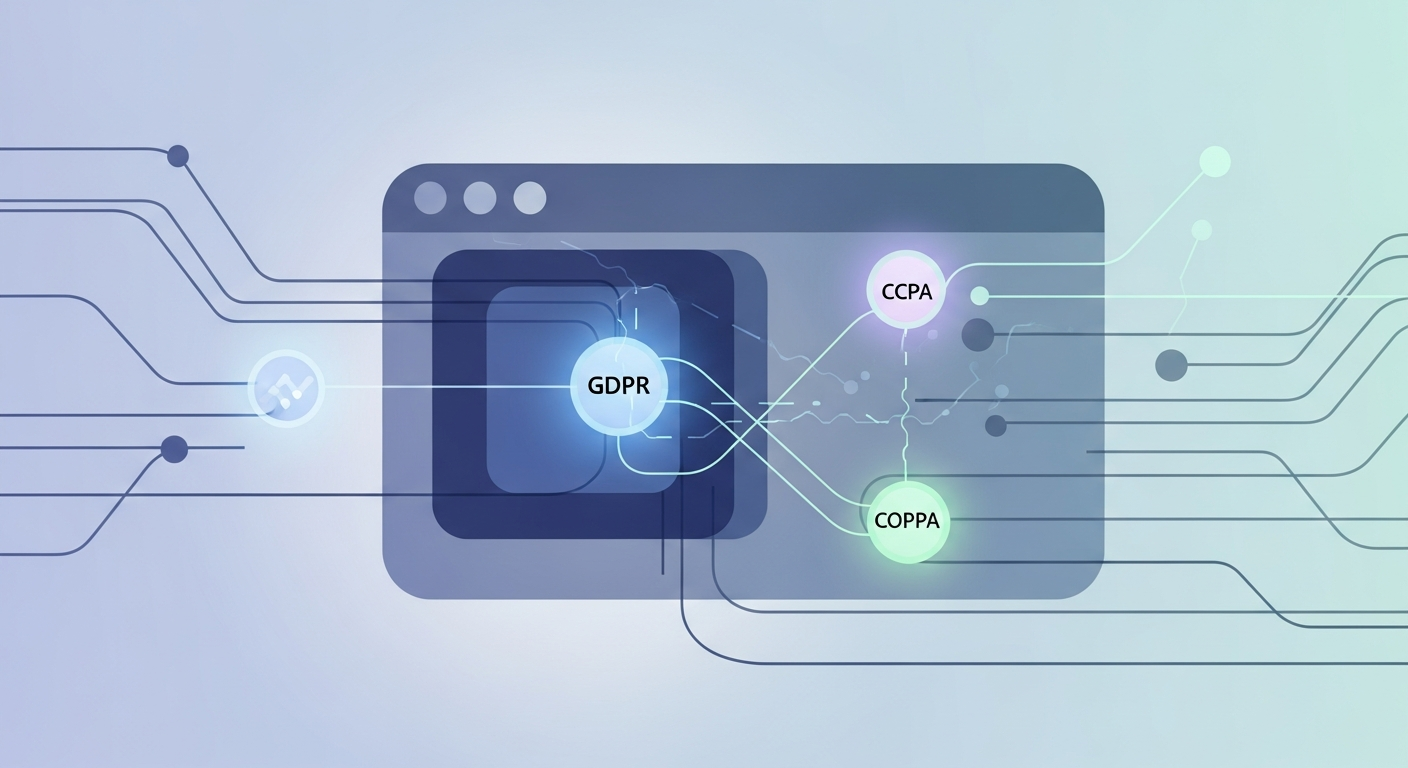
Understanding Active Compliance Testing
To mitigate the risk of silent operational failures, organizations must understand the distinction between passive compliance monitoring and active compliance testing. Traditional compliance tools rely almost exclusively on passive scanning. A passive scan operates as an observer: a headless browser visits a public website, analyzes the static HTML, inspects the Document Object Model (DOM), catalogs active cookies, and monitors outbound network requests to identify third-party trackers. This is highly effective for verifying that a cookie consent banner is present, checking that tag managers do not fire analytics scripts before consent is granted, or validating WCAG 2.1 AA accessibility standards such as color contrast and alt-text presence.
However, passive monitoring is fundamentally limited. It cannot verify what happens after a user interacts with a form, submits a request, or exercises a legal right. It cannot check if a "Do Not Sell or Share My Personal Information" link actually halts the downstream transmission of data, nor can it determine if a data subject access request (DSAR) is processed within the statutory deadline. Passive scanning stops at the boundary of user interaction.
Active compliance testing, by contrast, is behavioral, transactional, and continuous. It does not merely observe the site; it interacts with it. Active testing employs synthetic identities - programmatically controlled, isolated personas with unique email addresses, phone numbers, browser profiles, and simulated behavioral histories. These synthetic identities navigate the website exactly like a real user, executing complex, multi-step workflows to test the integrity of the organization's privacy promises.
For example, under the California Consumer Privacy Act (CCPA) and its subsequent amendments under the CPPA, businesses must provide functional mechanisms for consumers to opt out of the sale or sharing of their personal information. An active compliance test deploys a synthetic identity to visit the site, trigger the Global Privacy Control (GPC) signal or click the opt-out link, and then programmatically verify whether downstream network requests to third-party ad networks are successfully blocked on subsequent page views. By executing these transactions continuously, active testing preempts compliance regressions - those silent code failures introduced during rapid CI/CD deployment cycles that would otherwise go unnoticed until a regulator or a class-action plaintiff discovers them. To achieve this level of continuous validation without disrupting engineering resources, a highly automated testing framework is required.
The Mechanism: How Complyy's Active Tests Work
Complyy's continuous compliance observability platform implements active testing through a sophisticated, zero-integration architecture. Unlike legacy enterprise privacy software that requires complex software development kits (SDKs), custom API integrations, or intrusive code changes, Complyy operates entirely from the outside. It interacts with any public URL using a real headless browser running in a secure, isolated container environment. This ensures that the platform views and tests the site exactly as a real customer or a regulatory auditor would.
The workflow begins with domain discovery. When a customer adds a domain, Complyy automatically maps the public-facing footprint. It auto-discovers the cookie consent banner, locates the privacy policy and terms of service, identifies opt-out links - such as "Do Not Sell" or GPC handlers - and maps unsubscribe flows, age-gates, and third-party tracking scripts. This initial map establishes the baseline for both passive and active testing.
Once the baseline is established, Complyy's active AI agents execute behavioral tests using synthetic identities. These agents do not merely fill out forms with static dummy data; they act as dynamic, stateful users. The agent programmatically signs up for an account, submits a formal deletion or DSAR request via the public-facing form, and triggers opt-out signals. The platform then provisions a dedicated, monitored inbox linked to that specific synthetic identity. This allows the system to track the entire lifecycle of the request: it records the receipt of automated confirmation emails, processes identity verification requests, and monitors the inbox for the final resolution of the request.
Crucially, Complyy tracks these interactions against the legal clock. Different regulations impose strict, non-negotiable response windows. GDPR Article 12(3) mandates a 30-day response window for erasures; the CCPA allows 45 days for deletion requests under Cal. Civ. Code § 1798.130; and CAN-SPAM (16 CFR Part 316) requiring that unsubscribe requests be honored within 10 business days. Complyy's active agents monitor these regulatory deadlines in real time, calculating the exact days remaining. If an action is not completed as the deadline approaches, the platform triggers automated alerts, allowing the engineering and legal teams to intervene before the statutory limit is breached.

Detecting and Remediating Compliance Gaps
By simulating real user journeys, active testing surfaces critical operational regressions that passive scans and manual audits miss entirely. These findings are not theoretical vulnerabilities; they are active, verifiable compliance failures occurring on the live production site. In practice, Complyy's active agents frequently identify high-risk discrepancies between frontend interfaces and backend data flows.
A common failure mode occurs within cookie consent and tag management. A passive scan might verify that a cookie banner renders correctly on the homepage. However, Complyy's active agents often detect cases where a tag manager silently fires analytics or marketing pixels before the user has dismissed the banner or after the user has explicitly clicked "Reject All." This directly violates GDPR Article 7(3) regarding the ease of withdrawing consent, as well as CCPA requirements for honoring opt-out preferences.
Another frequent regression involves the "Do Not Sell or Share My Personal Information" link. An active test might find that clicking the link returns a successful HTTP 200 status code, but subsequent network logs reveal that the underlying behavioral tracking pixels continue to transmit data to third-party ad networks. The frontend UI indicates compliance, but the behavioral data stream remains unblocked.
Active testing also exposes vulnerabilities in age-gated compliance flows under COPPA (16 CFR Part 312). For example, an active agent attempting to register a minor account may find that while an age-gate is present in the markup, it can be bypassed simply by clicking "Back" and modifying the birth year, or by programmatically submitting the registration payload directly to the API endpoint without verifying parental consent. Similarly, the agent can detect CAN-SPAM violations where an unsubscribe link in a marketing footer leads to a broken page or fails to remove the synthetic identity from the active mailing list within the 10-day legal window.
"A compliance program is only as strong as its worst deployment. When active agents run continuously, they catch the moment a minor frontend update accidentally bypasses your consent logic or breaks a deletion pipeline."
When Complyy detects these failures, it does not simply issue a generic alert. It provides the precise technical context required for immediate engineering remediation. Every finding is accompanied by full-page screenshots, complete HTML snapshots, console error logs, and detailed HAR (HTTP Archive) network logs captured at the exact moment of execution. This comprehensive data package allows developers to trace the exact network request or DOM state that caused the failure, bypassing the need for lengthy reproduction cycles and enabling rapid hotfixes before regulators or class-action plaintiffs can exploit the gap. This immediate actionability is supported by a robust evidence framework designed to withstand legal scrutiny.
The Legal Moat: Complyy's Evidence Model
In the event of a regulatory inquiry or a class-action lawsuit, having internal logs or database timestamps is rarely sufficient. Regulators and courts require clear, verifiable, and tamper-proof evidence that demonstrates an organization's compliance posture over time. If your defense relies on easily modifiable databases or reconstructed frontend states, your legal position is highly vulnerable. Complyy addresses this risk by generating court-admissible evidence of compliance posture as a core product output.
Complyy's evidence model is built on an immutable, cryptographic chain of custody. When an active or passive test runs, the platform captures raw